

Blogs
Across Africa, evidence on the growing burden of non-communicable diseases (NCDs) is increasingly informing national health priorities. Yet, translating this evidence into sustained government financing remains a significant challenge. Despite the availability of cost-effective interventions and growing recognition of the economic consequences of NCDs, prevention and care continue to compete for limited public resources amid constrained fiscal space, rising debt-servicing obligations and declining external development assistance for health.
NCDs caused an estimated 4.7 million deaths across Africa in 2023, and the World Health Organization projects that they will become the leading cause of death in sub-Saharan Africa by 2030. The challenge, therefore, is not simply to generate more evidence, but to ensure that evidence informs policy choices, shapes budget priorities and ultimately translates into accessible NCD prevention and care.
Why investment cases matter: the bridge to political action
The first webinar titled “Making the Case for NCD Investments: Understanding the What and How” held on December 3, 2025, set out the purpose of an investment case. At its simplest, it answers three questions every finance ministry asks. What is the burden of NCDs, and what does inaction cost? Which interventions deliver the greatest health and economic returns? And what resources are needed to finance and sustain them?
By combining disease-burden data, costing, impact modelling and economic evaluation, an investment case translates health priorities into the language of finance. As Dr Julius Korir of Kenyatta University in Kenya noted,
“An investment case is the bridge between evidence and political action. It reveals the true cost of doing nothing.”
The session also stressed the limits noting that a positive return on investment does not guarantee funding, nor does it automatically make one intervention a higher priority than another. Affordability, equity, feasibility and opportunity costs all matter, and some interventions with modest financial returns remain essential for protecting vulnerable populations.
While the first webinar established why investment cases matter, the second demonstrated that their influence depends on the credibility of the underlying evidence and the feasibility of the proposed interventions.
Building cases that are credible and feasible
The second webinar titled “How to Develop NCD Investment Cases: Tools and Methods” held on March 26, 2026, focused on the analytical foundations. AFIDEP’s Dr André Zida reframed investment cases as dynamic decision-making instruments rather than static reports. Pointing out that they are tools that help governments prioritise interventions, model expected benefits and align resources.
Credibility rests on reliable data, transparent assumptions and a realistic view of health-system capacity. Tools such as the WHO OneHealth Tool support costing and scenario analysis, but they are only as good as the data fed into them and the judgement used to interpret results.
Drawing on Malawi’s experience, Dr Gerald Manthalu, Director of Planning and Policy Development, Ministry of Health, urged countries to start with what governments can actually sustain as feasibility proved as important. He said, “We are mostly looking at the government budget as the core because other financing sources are less predictable.” He also called for a whole-of-government approach, since NCDs are shaped by education, environment and lifestyle as much as by health services. Mr. Labram Massawudu Musah, Executive Director, Vision for Accelerated Sustainable Development (VAST)-Ghana, made the case for focus, noting that targeted investment allows governments to invest in prevention and health promotion, not just treatment.
From evidence to budgets: the hardest step
The third webinar titled “From Evidence to Action: Using NCD Investment Cases for Budgeting and Financing Decisions” held in June 18, 2026, brought together participants from Cameroon, Ghana, Kenya, Nigeria, Rwanda, Somalia, Tanzania, Uganda and Zimbabwe. It confronted an uncomfortable truth where many countries complete investment cases, engage stakeholders and issue recommendations, yet still struggle to secure financing.
“An investment case is not an end in itself,” Dr Zida reminded participants. “It is a tool to support policy dialogue, resource mobilisation and decision-making.” Investment cases gain traction when they are timed to national budget cycles, communicated in formats senior decision-makers can use, and built with ministries of finance and planning from the start, not presented to them at the end.
The third webinar moved the discussion beyond analytical quality to the more difficult question of how governments can translate investment-case recommendations into actual financing commitments.
Country experiences: Different challenges, shared financing ambitions
Country experiences shared across the FAN webinar series illustrated how governments are approaching NCD investment cases within different institutional, economic and health-system contexts. The discussions highlighted the importance of using locally relevant evidence, identifying focused investment priorities, aligning proposed interventions with government financing capacity and ensuring that analytical findings inform policy and budget decisions.
Kenya: Using local data to inform investment priorities
Kenya’s experience highlighted the potential of using local data to inform investment decisions for cardiovascular disease (CVD) prevention and care. Dr David Njuguna from the Ministry of Health presented modelling informed by health insurance claims data and national health information systems. The analysis demonstrated how earlier screening and improved outpatient care could reduce dependence on costly inpatient treatment. The discussion also highlighted the scale of household financial hardship associated with NCDs, with approximately 28% of households reported to be pushed into poverty by NCD-related costs. Despite estimated annual NCD expenditure of approximately US$850 million, government contributions remain relatively low. Kenya’s experience demonstrates how locally generated evidence and economic modelling can help identify opportunities to improve service delivery, strengthen preventive care and make a stronger case for increased public investment in NCDs.
Ghana: Focusing investment cases on specific policy priorities
Ghana’s experience demonstrated the value of developing focused investment cases around specific diseases and risk factors rather than attempting to address the entire NCD burden through a single analysis. Mr Labram Musa, Executive Director of Vision for Accelerated Sustainable Development (VAST-Ghana), drew on experiences in tobacco control and mental health to illustrate how targeted investment priorities can inform policy action. He emphasised that focusing on specific areas enables governments to identify appropriate interventions and strengthen investment in prevention and health promotion, rather than concentrating resources primarily on treatment. The discussion highlighted the importance of linking economic evidence to clearly defined policy priorities so that investment cases can inform practical decisions on NCD prevention and control.
Malawi: Aligning investment priorities with government financing capacity
Malawi’s experience emphasised the importance of grounding NCD investment priorities in realistic and predictable financing arrangements. Dr Gerald Manthalu, who shared Malawi’s experience in developing and implementing investment cases, highlighted the central role of government budgets, noting that alternative financing sources are often less predictable. His contribution reinforced the need to consider affordability and sustainability when identifying interventions for investment. Proposed investments must account for the resources required to implement and maintain services, including healthcare personnel, medicines and diagnostics. This experience highlights the importance of developing costed priorities that reflect available government financing capacity and can be implemented progressively where immediate large-scale investment is not feasible.
Uganda: Moving from investment-case development to government commitment
Uganda’s experience, discussed during the June 2026 webinar, highlighted the challenge of translating completed investment-case analyses into government financing commitments. The country had developed an NCD investment case with support from World Health Organization (WHO) and United Nations Development Programme (UNDP), examining the economic burden of NCDs, the costs and potential impacts of interventions, and expected returns on investment. However, securing government buy-in and ensuring that NCD priorities are adequately reflected in existing resource-allocation mechanisms remain important challenges. Dr Frank Mugabe, Principal Medical Officer in the Ministry of Health’s NCD Department, highlighted the importance of strengthening government engagement to advance these priorities. Uganda’s experience demonstrates that completing an investment case is only one part of the process; sustained engagement with decision-makers, particularly in finance and planning institutions, is necessary to translate analytical findings into budgetary and implementation decision
Somalia: Making the case for sustainable domestic financing
Somalia’s experience highlighted the financing and service-delivery constraints affecting access to NCD prevention and care. During the March 2026 webinar, Omar Abdulle, Chief Executive Officer of Gapbridge Institute for Research and Consultancy, highlighted that “nearly half of households were unable to seek care because of costs and the limited availability of basic NCD services.” The discussion also pointed to ongoing efforts to strengthen universal health coverage, expand NCD monitoring and integrate recommended interventions into primary healthcare. These experiences demonstrate the importance of identifying strategic investments that can expand access to essential NCD services, even in resource-constrained settings. The June 2026 webinar further highlighted Somalia’s interest in reducing reliance on external financing. Dr Khalid Mohamud of the Ministry of Health discussed the potential role of an NCD investment case in supporting engagement with government and exploring domestic resource mobilisation options, including health taxes and possible levies on telecommunications and aviation.
Cross-country learning: Adapting approaches to national contexts
These experiences demonstrate that countries face different challenges in translating NCD investment evidence into policy and financing decisions. Kenya highlights the value of local data and economic modelling; Ghana demonstrates the importance of focused investment priorities; Malawi emphasises alignment with predictable government financing; Uganda illustrates the challenge of securing government commitment after completing an investment case; and Somalia highlights the need to strengthen access to NCD services while exploring sustainable domestic financing options. Together, these experiences reinforce the importance of country-led approaches, tailored technical support and cross-country learning to strengthen the use of investment cases in advancing sustainable NCD financing.
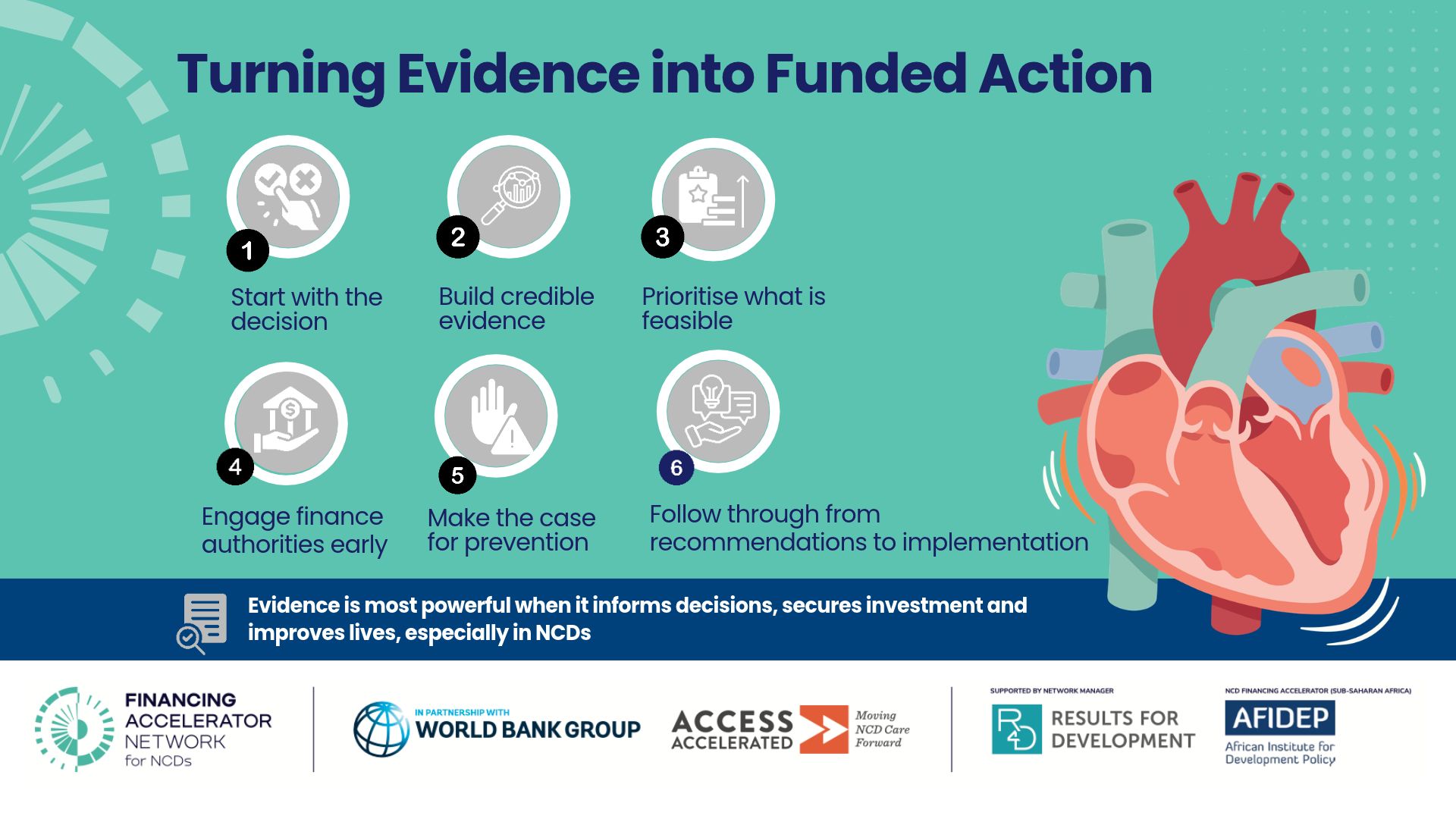
Six lessons for turning evidence into funded action
Taken together, the three webinars point to six practical lessons:
- Start with the decision. Define the specific policy or financing question the investment case must answer before any modelling begins.
- Build credible evidence. Use the best available local data, transparent assumptions and sound costing and modelling methods.
- Prioritise what is feasible. Weigh health gains against affordability, equity and the health system’s capacity to deliver.
- Engage finance authorities early. Bring ministries of finance and planning in from the outset, and align recommendations with budget cycles.
- Make the case for prevention. Show the long-term returns of investing in prevention, screening and early diagnosis, not just treatment.
- Follow through from recommendations to implementation. Track whether investment-case findings inform policy commitments, enter government budget proposals, receive approved allocations, translate into actual expenditure and ultimately improve service delivery and health outcomes. Approval of a budget does not necessarily mean that funds are released or spent.
Conclusion
The central message emerging from the three FAN webinars is that an NCD investment case is a process, not simply a technical report. Its success should be measured not only by the quality of the analysis, but by whether it influences policy priorities, informs government budget decisions, mobilises sustainable resources and improves access to NCD prevention and care.
For FAN and its partners, this calls for continued investment in country-led technical support, stronger engagement between health and finance authorities, and sustained cross-country learning. Countries must move beyond demonstrating why NCD investment matters to establishing how priority interventions can be financed, implemented and monitored.
Evidence alone will not close Africa’s NCD financing gap. Translating that evidence into funded priorities requires political commitment, credible financing pathways, institutional collaboration and deliberate follow-through. This is where NCD investment cases can make their greatest contribution.
This blog is part of the Financing Accelerator Network for NCDs (FAN) Learning and Exchange Series. Explore the individual webinar blogs: Making the Case for NCD Investments; Strengthening NCD Investment Cases in Sub-Saharan Africa; and From Evidence to Investment: Closing Africa’s NCD Financing Gap.