

News
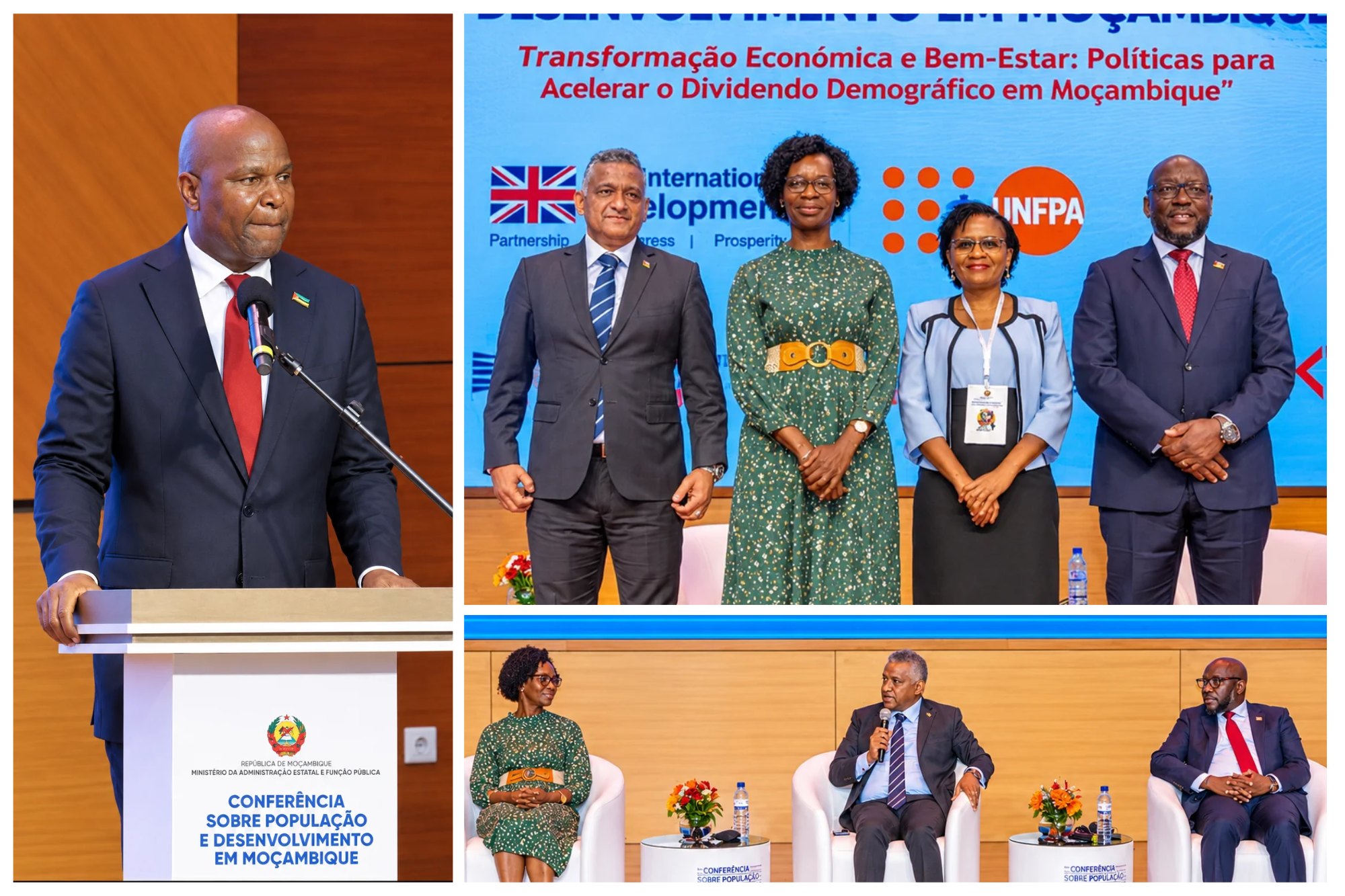
Mozambique’s future prosperity depends less on its gas, coal and minerals, than on how well it invests in its people. That was the central message of Dr Rose Oronje, AFIDEP’s Deputy Executive Director, who gave the keynote address at the Conference on Population and Development in Mozambique.
In her keynote entitled “How can Mozambique harness its demographic transition for accelerated development for its people?”, Dr Oronje said the country stands at a decisive moment. “A young population does not automatically produce a dividend. The size of the dividend depends on the investments Mozambique makes to accelerate fertility decline and to develop its people,” she said.
The two-day conference, held on 4 and 5 November in Maputo, was organised by the Ministry of Planning and Development with the United Nations Population Fund (UNFPA). Under the theme “Population, Economic Transformation and Well-being: Policies to Harness the Demographic Dividend in Mozambique”, it brought together government, development partners, academia, the private sector, youth and women’s organisations, and civil society.
H.E. President Chapo: The economy must grow faster than the population
The conference was officially opened by His Excellency Daniel Francisco Chapo, President of the Republic of Mozambique. The President decried the current rapid population growth, which has outpaced economic growth and left many Mozambicans living in poverty. He noted that Mozambique has grown from about 10 million people at independence in 1975 to about 35 million today, and could reach 60 million by 2050.
The President committed his government to take advantage of the country’s large young population by investing more in education, healthcare, vocational training and job creation. The government will “build more schools, train teachers, and ensure that more children, especially girls, remain in school and complete their studies,” he said. “In the health sector, the government will continue prioritising primary healthcare, maternal and child health, and the fight against chronic malnutrition.”
Twenty-two million more Mozambicans by 2044
Agreeing with the President’s speech, Dr Oronje noted that Mozambique was going to add 22 million people to its current population of about 35 million by 2044, the final year of the country’s National Development Strategy (ENDE 2025–2044). The projected population of about 56 million in 2044 will need schools, clinics, homes and jobs.
She cautioned that if the government does not make substantive and sustained investments in people, this rapid population growth will worsen the increasing levels of poverty and inequality in the country. Currently based on government data, children in the four poorest provinces in Mozambique (namely Cabo Delgado, Nampula, Niassa and Zambézia) are 45 times more likely to be poor than children in Maputo.
Two levers: accelerate fertility decline, and invest more in human capital development
Dr Oronje urged the country to prioritise two levers in efforts to harness a sizeable demographic dividend from its large young population. The first lever is accelerating fertility decline. Births per woman fell from 5.9 in 2011 to 4.9 in 2022–23, but over 25 years the decline has been only 0.3 births. Yet women want fewer children than they are having: nearly one in five women of reproductive age wants to avoid pregnancy but is not using modern contraception. Dr Oronje pointed to neighbouring Malawi, where modern contraceptive use among married women rose from 7% in 1992 to 66% in 2024, and fertility fell from 6.7 to 3.7 births. In Mozambique, about 28% of married women use a modern method.
The second lever is investing in human capital, which she described as an emergency in the country. Of every 100 Mozambican children, about 54 complete primary school, 28 complete lower secondary, 18 complete secondary and only 8 reach university. Of some 3.4 million young people aged 18 to 22, about 253,000 are in universities and 122,000 in technical and vocational training: only one in nine. More than a third of children under five are stunted.
The jobs picture is just as stark. “Every year about half a million young people enter the labour market, but the formal economy creates only about 25,000 jobs: one for every twenty,” Dr Oronje said. The fastest-growing sectors create the fewest jobs: extractives produce about 11% of GDP but only about 1% of jobs, while agriculture employs 70% of workers at very low productivity. Between 80% and 90% of Mozambicans work informally.
Harnessing a sizeable dividend is a policy choice
The good news, Dr Oronje said, is that the size of the dividend that Mozambique can harness is a policy choice. Modelling led by the then Ministry of Economy and Finance with UNFPA and AFIDEP in 2015 showed that economic reform alone raises incomes, but combining it with investment in people (including investment in family planning, education and health) delivers far more: about US$8,440 per person by 2051, against US$4,890 with economic reform alone.
Because those projections were based on 2011 data, she called for updated evidence: new demographic dividend modelling and National Transfer Accounts aligned with the ENDE 2025–2044. AFIDEP stands ready to support the National Institute of Statistics and the Ministry, as it did in 2015.
She set out three pathways:
- Accelerate fertility decline through voluntary, rights-based family planning. More than half of Mozambique’s contraceptives were historically supplied by USAID, and almost all US family planning aid was cut in 2025. A domestic budget line for contraceptives that rises every year is now urgent, with youth-friendly services and priority to the north and centre.
- Reform education and skills. Every child reading by Grade 3; girls kept in school by scaling up proven programmes such as Eu Sou Capaz, which cut girls’ dropout by 13% in the schools it reached; and technical training linked to employers.
- Create productive jobs at scale. Make informal work more productive and extend social protection to it; invest in agribusiness and agro-processing; and link gas and mining to local suppliers, investing resource revenues in people.
Above all, she urged a shift from strategies and pilots to budgeted programmes: financed domestically, protected in every budget, tracked publicly, and focused on the provinces with the greatest need.
A shared agenda
The President’s commitments to schools, teachers, girls’ education, primary healthcare and the fight against chronic malnutrition closely match the investments the keynote identified as essential. The conference’s seven thematic sessions covered the demographic transition, health, education, employment and skills, gender and social protection, climate change and cities, and financing for the demographic dividend. Its discussions are expected to feed into the proposed new National Population Policy and the Maputo Declaration on commitments.
_________________________________________________________________________________________
Photo captions:
First photo: President of the Republic of Mozambique, H.E. Daniel Francisco Chapo, who officially opened the Conference on Population and Development.
Second photo: AFIDEP’s Dr Rose N. Oronje following her keynote address, alongside Hon. Ivete Ferrao Alane, Minister of Labour, Gender and Social Action; Hon. Salim Cripton Vala, Minister of Planning and Development; and Hon. Caifadine Paulo Manasse, Minister of Youth and Sports.
Third photo: Government ministers taking part in a panel discussion during the conference.