


Blogs
Every year on 11 July, Africa commemorates African Anti-Corruption Day, marking the adoption of the African Union Convention on Preventing and Combating Corruption (AUCPCC). This year’s theme, “Scaling Up the Promotion of Integrity and Anti-Corruption Actions Across Africa,” calls on member states and stakeholders to strengthen integrity systems across the continent. One practical way to advance this goal is by accelerating the digitalization of public procurement processes.
On the continent, despite several initiatives to fight corruption, including the continent-wide adoption of the AUCPCC, corruption remains a major obstacle to achieving sustainable development. It is estimated by the African Development Bank (AfDB) that corruption drains almost US$10 billion annually from African economies, underscoring the significant effect corruption has on development on the continent.
While corruption in Africa affects various sectors, public procurement remains the most susceptible, given the high volume of contracts and financial transactions involved in procuring goods and services essential to service delivery. In public procurement, corruption is visible through abuse of office, embezzlement, and bribery. The practices not only distort competition by favoring those who pay bribes over businesses with genuine potential to drive economic growth but also create inefficiencies that impact public service delivery.
Data shows a close relationship between weak accountability and transparency mechanisms in public procurement processes and elevated levels of perceived corruption in Africa. For example, more than 80 percent of the lowest-ranked countries in the public procurement process indicators in the Africa Integrity Indicators rank among the bottom ten in the 2025 Corruption Perceptions Index[1].
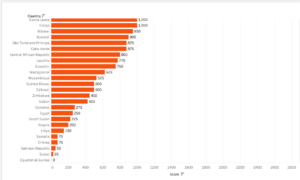
Figure 1: Lowest-ranked African countries in the public procurement processes indicators on the Africa Integrity Indicators 2025 data
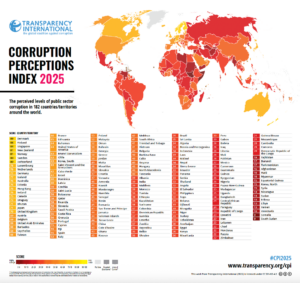
Figure 2: Country rankings on Transparency International’s Corruption Perceptions Index 2025
Over the years, there have been notable efforts by African countries to strengthen oversight and legal frameworks to fight procurement-related corruption. The AUCPCC is one of these efforts and has contributed to notable progress towards preventing and combating corruption in Africa. By promoting awareness and commitment, the convention has heightened understanding of the detrimental impacts of corruption, and, through public will, many leaders have committed to fighting corruption, leading to the establishment of national-level anti-corruption policies and frameworks. The establishment of legal frameworks, cross-border collaboration, information sharing, recovery of stolen assets, and regional cooperation are worth mentioning as the successes of the convention.
Several African countries have begun digitalizing public procurement, supported by institutions such as the World Bank, the International Monetary Fund, and the African Development Bank. These reforms aim to strengthen transparency, improve efficiency, and reduce opportunities for corruption. Digitalizing public procurement processes offers countries potential benefits, including enhanced transparency and accountability and improved public sector efficiency through reduced administrative burdens, red tape, and bureaucracy. Also, as argued by the World Bank it promotes the inclusion of Small and Medium Enterprises (SMEs), which account for more than 90 percent of all businesses in Africa.
Understanding why procurement is particularly vulnerable to corruption requires examining how the procurement process works. Globally, public procurement is a key element of any government. It enables the effective execution of national budgets and the provision of essential public goods and services. However, given the volume of financial transactions involved, public procurement processes are highly susceptible to corruption and in Africa are seen as a way to riches. As indicated by the UN Office on Drugs and Crime, the public procurement process involves pre-selection activities, tendering, bid evaluation, post-selection activities, and record-keeping and auditing. Corruption can occur in any stage and could be manifested through practices like collusion between procurement officials and suppliers, and bribery.
In Africa, corruption in these stages is more likely to occur due to weak oversight mechanisms, reliance on manual processes, and political interference. Weak asset declaration systems for civil servants and inadequate political private financing regulations further increase the likelihood of corruption occurring in these stages.
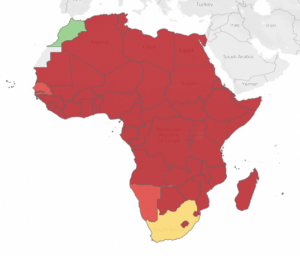
Figure 3: Status of political parties’ declarations of private donations in Africa as of 2025 based on data from the Africa Integrity Indicators
In Africa, the use of manual processes in public procurement has been the norm for decades due to weak capacity, low levels of internet penetration, and inadequate digital infrastructure. This has contributed over time to a lack of accountability and transparency, and eventually declining public trust in the procurement processes. The Africa Integrity Indicators data show that countries that perform poorly on public procurement indicators have no or dysfunctional digital procurement platforms for posting tender details. For example, in Equatorial Guinea, the lowest ranked country in the public procurement indicators within the Africa Integrity Indicators, a basic website for advertising tenders, publishing selection criteria, and listing blacklisted companies does not exist. In contrast, Rwanda, one of the best-ranked countries, has implemented a digital procurement system that enables vendors, contractors, and suppliers to participate without direct interactions with government officials, thereby reducing corruption risks. Also, the procurement authority, the Rwanda Public Procurement Authority (RPPA), has a website where citizens can access the list of backlisted companies (those prohibited from participating in public procurement processes for various reasons, including flouting public procurement procedures) and the list of awarded tenders. Although better-performing countries have embraced digital technology in procurement processes, governments still tend to opt for opaque contract awarding, particularly in sectors such as natural resource exploitation, energy, transport, and infrastructure.
There is no doubt that the digitalization of procurement processes in Africa presents an opportunity to enhance transparency and accountability, especially given the ongoing drive by African governments towards the digitalization of government services. For example, digital platforms have the potential to minimize physical interactions between suppliers and public procurement officers, reducing opportunities for bribery and favoritism. Interestingly, while some countries like Rwanda, Mauritius, and Zambia have made notable progress in digitalization, widespread implementation across the continent remains limited due to capacity constraints, infrastructure deficits, political resistance, and low internet penetration rates. Multilateral organizations have contributed to digitalization efforts on the continent, but overcoming these challenges requires stronger political will, investment in digital infrastructure, and capacity-building initiatives to support the transition to digital procurement systems.
Digitalization could be an answer to these challenges by automating processes, reducing human contact, promoting transparency, creating a real-time monitoring system, and breaking information asymmetries and monopolies in power. The introduction of the Bureau of Public Procurement and the e-procurement platform in Nigeria has enhanced transparency in procurement processes and thus created more room for better tracking of public expenditures. Ghana has made a similar move by introducing an e-procurement system within the Public Procurement Authority to promote transparency and make procurement data available to the public. In Senegal, the e-procurement system has ensured effective time management in completing procurement cycles, leading to faster project implementation. The centralized procurement database in Burkina Faso has improved access to information on public procurement, creating an ease for suppliers to find relevant opportunities.
In conclusion, as African Union member states continue to expand digital public services, public procurement should be at the forefront of this transformation. Digital procurement systems not only improve efficiency but also strengthen transparency, accountability, and public trust. While digitalization alone cannot eliminate corruption, it significantly reduces opportunities for abuse and provides stronger mechanisms for oversight. Accelerating the adoption of e-procurement across the continent should therefore be viewed not merely as a technological reform, but as a governance imperative for achieving sustainable development.
[1] For public procurements, bottom 10 countries based on cumulative points scored include Equatorial Guinea, Sudan, Eritrea, Somalia, Libya, Angola, South Sudan, Egypt, Comoros, Gabon, and Zimbabwe. For the Transparency International’s corruption perception index 2025, the bottom 10 African countries (based on points with some countries scoring the same points) include South Sudan, Somalia, Libya, Eritrea, Sudan, Equatorial Guinea, Burundi, Democratic Republic of Congo, Comoros, Mozambique, Guinea-Bissau, Zimbabwe, Chad, Eswatini, Congo, Central Africa Republic