


Blogs
Across Africa, governments still shoulder less than half of total health expenditure, while out-of-pocket spending remains high, averaging about 30% to 40% of total health costs in several low- and middle-income settings, exposing households to financial hardship. At the same time, external aid continues to play a significant role, accounting for up to 40% of health financing in some low-income countries, highlighting persistent dependency and vulnerability as donor priorities shift.
Towards integrated and sustainable financing models
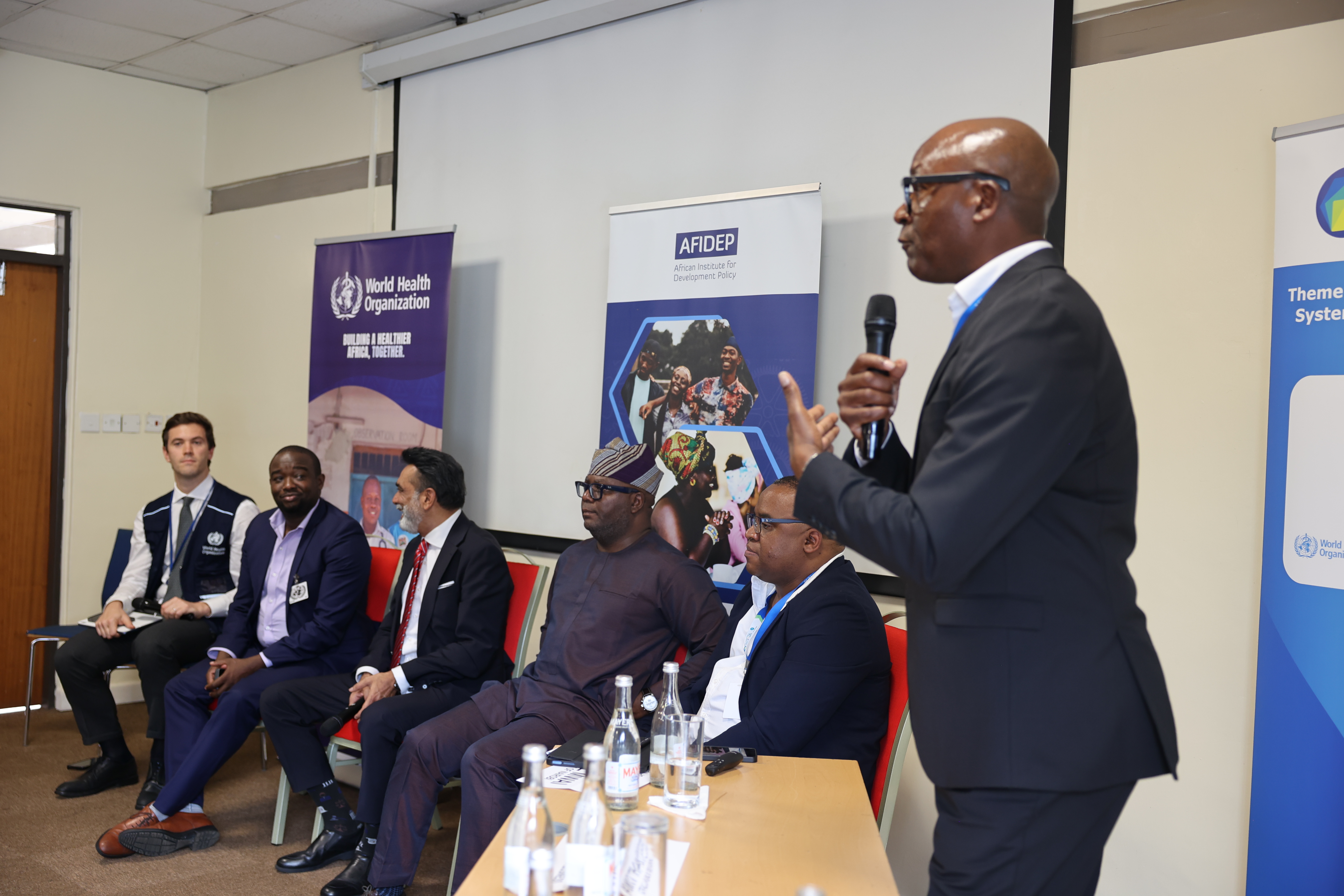
Against this backdrop, the discussion at the side event titled “Financing Universal Health Coverage: Domestic Resource Mobilisation (DRM), Private Sector, and Philanthropic Partnerships,” convened by African Institute for Development Policy during the World Health Summit (WHS) Regional Meeting held on 27 April 2026 in Nairobi, called for African countries to transition from externally driven and fragmented health financing models toward more integrated, efficient, and locally owned systems that can sustainably finance universal health coverage (UHC) in a rapidly changing global financing environment.
During the session, delegates noted that the role of private sector and philanthropic partnerships as potential source of finances for healthcare and health systems in a macro-fiscal constrained environment cannot be overlooked. The dual burden of communicable and non-communicable diseases requires substantial investment to improve health service delivery to the people to achieve economic productivity that can help to reduce the disease burden. African countries were urged to recognise that, amid the current declining trend of donor support, governments alone cannot meet the health financing needs. They were encouraged to attract private sector investment through well-structured public-private partnerships (PPPs).
The private sector was identified as no longer peripheral but already central to healthcare delivery in Africa. The focus should be to create an enabling ecosystem with clear rules and regulations that attract, organise, and sustain private sector participation across the health system. PPPs should be seen as part of a “dual healthcare model”, where both public and private sectors are essential and complementary to improving health outcomes.
Similarly, philanthropists were identified as a potential source of financing for healthcare and health systems contributing about 8-10% of health budgets. However, African countries need to reposition philanthropy as a catalytic force that supports innovation, de-risks reforms, and strengthens systems rather than substituting government financing. Philanthropic capital can have greater impact when it’s strategically coordinated and aligned with national systems. This includes investing in government capacity and strengthening local institutions to ensure they independently sustain service delivery over time.
To maximise long-term value, philanthropists should shift towards supporting core systems enablers such as public financial management (PFM), payroll systems, data infrastructure, procurement reforms, insurance design, domestic revenue and expenditure systems and sub-national execution, which are essential for efficiency and long-term sustainability.
Building resilient and efficient health systems
One of the speakers called for a shift in mindset among policymakers to recognise health as a productive investment that can generate economic returns and support broader development to achieve rapid economic growth. The heterogeneous nature of countries in understanding health as an economic rather than social good will position African countries at different levels of development over time in gains associated with health investment.
For resilient health systems, countries should go beyond simply having more resources and instead focus on how systems are structured and financed. A resilient health system is characterised by liquidity that enables quick access to funds, flexibility to adapt and respond to changing needs, and domestically available resources to address health issues when need arises.
The Kenya Facility Improvement Financing (FIF) model was identified as one of the resilient financing mechanisms as it increases access to and use of resources in case of emergency without having to wait for long bureaucratic approvals. “Resilient isn’t having money on paper, but having money that you can actually spend when there is a crisis without waiting for approvals.”
However, many African health systems still lack these resilience attributes due to fragmented donor funding, short-term financing cycles, and parallel implementation structures that undermine national systems.
Rising public debt across many African countries is constraining fiscal space, while economic growth in many context remains too slow to generate sufficient extra revenue each year to build more health budgets or any other social budget. Private equity was identified as a key innovative financing mechanism to finance capital intensive infrastructures such as roads and recoup their investments over time while the government redirects the saved resources to provide social services such as health, education and security. In addition, strengthening governance and accountability and addressing leakages, corruption, and inefficiencies in expenditure management is also critical to direct resources towards priority needs of the people.
Conclusion
Financing UHC requires strategic and integrated approach that combines domestic resource mobilisation, private sector investment, and philanthropy, rather than relying on a single source. The overarching message, from the event, was that achieving UHC will require a comprehensive, locally viable and integrated financing approach that goes beyond increasing public budgets to include efficiency improvements, tax reforms, reprioritisation and stronger alignment of all financing sources. Despite the challenges, the speakers emphasised that progress is achievable, and the path toward locally financed and sustainable health systems is both necessary and within reach.
The AFIDEP session was moderated by AFIDEP’s Executive Director Dr Eliya Zulu and brought together a panel of distinguished speakers, including Dr Jackson Otieno, Senior Research and Policy Analyst at AFIDEP; Mr Richard Matikanya, Deputy Executive Director for Africa at CIFF; Dr Amit Thakker, Executive Chairman of Africa Health Business; Dr Daniel Mwai, Health Economist and Presidential Advisor on Health Financing in Kenya; Dr Babatunde Omilola, Head of the Public Health Security and Social Protection Division at the African Development Bank (AfDB); and Dr Andrea Luciani, Team Lead for External Relations and Partnerships at WHO.